




Archive | Selling More

Aligning Your Sales With Your CRM Tools

Posted on 04 January 2010 by Bob Ritter

If you’ve ever taken my basic end-user GoldMine training, you’ve heard me say “do your day.”  One of the key points about a workgroup CRM system for the sales team (reps, support, management, etc.) is that everyone should just do their day, the same way, in GoldMine!

The famous comedian Jack Benny once humored, “How do you get to Carnegie Hall?  Practice!”

A workgroup of CRM users is like an orchestra in that everyone has their role and needs to play their part well, but no matter how good we all play, it will only sound good if we’re all playing at the same time off the same sheet of music. 

GoldMine Premium provides you many tools for aligning the day-to-day life of your sales people, including but not limited to email and letter templates, fields for collecting qualifying information, a means of tracking activities and planning future follow-up, opportunity management, a seamless basis for providing the data that is needed by marketing and management, and much more! 

It’s important to get your prospects into the hands of an effective salesperson.  But when that salesperson is also a capable user of a CRM system that is aligned to the way they do their job, you have an even greater result.   In addition to that salesperson achieving greater sales productivity, your whole business can thrive as you achieve the synergy that comes from a sales team that is able to function far better with one another, their support staff, marketing, and management!

Comments (0)

Raising The Bar With The GoldMine Task Bar!

Posted on 07 August 2009 by Bob Ritter

One of the many advantages of GoldMine® over other CRM applications is the GoldMine® Task Bar.

The GoldMine Task Bar is a great way of having quick, one-click access to common things like:

  • GoldMine Main Menu Items
  • Launching external applications and web sites (web resources like Google Maps, Dun and Bradstreet, Spoke, etc.)
  • Displaying documents and files in GoldMine
  • Using and Sharing Macros

In addition, GoldMine users with master rights can customize the task bar to allow all users access to frequently used menu commands and macros.

What’s more, task bars can be Global (for all users) or Local (just for each user).

Each icon on the task bar represents a task item (essentially a short cut). You can customize up to 50 task items into one task group. In other words, a task group is a collection of tasks [task item]. Each task grouping is accessed from a pull-down button on your GoldMine Task Bar, and you can have up to 20 task groups.

Here’s how to create a new task bar group:

  1. Click on the Customize option on your tool bar task bar
  2. Right click on the task bar
  3. Select “Add New Group”
  4. Give it a name and select “OK.” (Users with master rights can check the box “Global Group” if they want to give all end users access to the task bar)
  5. Start inserting items to the new group

Click here to see the benefit of using the GoldMine® Task Bar!

Click here to learn how to take your productivity to the next level with the toolbar/taskbar and templates

Comments (0)

Dial the Phone with GoldMine

Posted on 07 March 2009 by Jay Dymond

What image do you conjure up when you think of someone who’s selling?  Possibly you pictured someone talking on the phone.  Surely you’ve heard the expression “dialing for dollars” as a way to describe the daily efforts by salespeople and telemarketers to reach prospects and customers. 

Whether you’re cold calling, introducing yourself to new web leads and referrals, following up on active prospects and customers, or fielding incoming inquiries, a large ratio of sales activity takes place on the phone.  And, when you’re on the phone you should be on the record. 

As a GoldMine trainer my number one basic principle for success with GoldMine is to “be on the record!”  Look over the shoulder of anyone in my office who’s on the phone and you’ll see what organization they’re talking with because that’s the GoldMine Record on their computer’s screen.  You have to be on the record you’re talking with in order to use GoldMine for the reasons you purchased it, not to mention to improve the quality and accuracy of the information you have.

For my organization, and others, the use of the phones is a big enough factor that we believe it warrants having tight integration between your phone system and your GoldMine database. 

Apart from the features of your phone system alone, here are compelling reasons for tight integration between GoldMine and your phones:

  • Screen pops based on incoming caller ID can save time searching for the GoldMine record
  • Automated capture of incoming callers phone number can prove very useful
  • Speed dialing with GoldMine reduces wrong dials and increases productivity as much as 15%
  • Power dialing outbound call campaigns to a call list where you can lift productivity by as much as 30%
  • Automate tracking calls by automatically initiating a “completed call” and capture the actual call duration
  • Automate scheduling follow-up with a Macros on a record of frequent call outcomes to reduce data entry time and increase selling time
  • Better call tracking in the context of your CRM records means enhanced reporting and greater accountability

The bottom line – you’ll sell more!

It just makes common sense – if you’re going to put people’s phone numbers into your GoldMine database you should let your GoldMine database dial the phone for you!  Once you start dialing with GoldMine you’ll wonder why anyone would want to otherwise.

Let us give you a demonstration of what you can do with GoldMine using your existing phone system.  That’s right, your existing phone system! 
Register for our online event – Telephony Integration – GoldMine and Your Current Phone System – what you don’t know that you can do

Great News - First Direct can integrate GoldMine with just about any phone system! If you’re a small business looking for a new phone system I’d be happy to tell you what phone system we changed to recently and why I chose it. We’ve reduced our phone bills nearly 50% in the process!
FEATURED ADD-ON:

Tapi Link for GoldMine – Once installed, Tapi Link for GoldMine becomes an integral part of your GoldMine and enables users to dial directly from within GoldMine and present a caller’s contact details when the telephone rings.

Comments (0)

Adding a “Personal Touch” to a Mass Email

Posted on 07 September 2008 by Jay Dymond

Here’s an effective way to give a “mass email” a personal touch and thereby lift response.   In other words, if your firm has developed fancy HTML email templates in your GoldMine Document Template library this is an easy way to enhance them when you want to give them a ‘one-to-one’ tone.

Start by making a clone (copy) of the template so that the original is not altered.   In the new template simply add lines (using your “return key”) above the designed template.  Then you can edit the top of the email with GoldMine merge fields to enter the first name and perhaps a short message — the shorter & sweeter the better.  I like to keep such a message to two or three sentences at most and to make the tone of the message feel like it was written to just one person. 

Because the formatting at the top of the email, where you want to add the text, will be dictated by HTML coding inside the template, you probably will need to alter the font and even the alignment of what you’re adding.  This can be done inside the GoldMine email client without altering the style of the actual template below.

With a personal salutation and the right personal note at the top of an HTML template, even if you broadcast this to group or filtered list of GoldMine records, this approach will still create the sense that you wrote to the recipient individually.   Doing so tends to invite a dialogue that doesn’t occur generally with mass broadcast emails.  So whether you send to one contact or a thousand records, this method can trigger a level of response that may pleasantly surprise you. 

Given the “personal feel” of the message, you’re apt to get responses which may not even relate to the primary marketing message.  Recipients may take the occasion of your email to ask you for something or to tell you something that was on their mind.  Either way, any response is an interaction that marketers want and sales people need!

(NOTE: If you’re managing replies to your campaigns with GoldMine Email Rules, you may need to pay more attention to what the respondent is saying.)

Comments (0)

Got Skills?

Posted on 01 July 2008 by Jay Dymond

From surgeons to carpenters, from police officers to accountants … every profession uses tools.  And, so it is with sales professionals.  CRM is far and away one of the most important tools in a salesperson’s toolbox!

Professionals need to know the terminology, trends, and facts in their field.  They need an understanding of their customers’ wants, needs, and objections.  They must also be familiar with best practices, pitfalls, and patterns which lead to success.  But all this is not enough!  They must also be highly skilled on the tools of their trade. 

There’s an applicable expression, which I’m not a fan of, – “Those who can, do, and those who can’t, teach.”   This expression gives all teachers a bad rap because many teachers are talented professionals who can easily work in the field that they teach, and have. They just love to teach.  Nonetheless, this saying does make a point – if you know a lot about a field, but you can’t use the “tools of the trade,” you might have a career as a teacher, but not as a practitioner.

CRM technology is a chief sales tool, and a skillful CRM user has a competitive advantage. Yet most salespeople barely use a fraction of their CRM’s capabilities and many struggle to use even the basic features, regardless of what CRM product they have.  Why is that?

I’ve heard all the excuses … I don’t have the time or I’m out of the office. It’s too hard to use.  It doesn’t do this or that.  I’m not good at computers.  These are cop outs!  Here’s why salespeople aren’t skilled CRM users:

1. Lack of Effort – You can’t expect someone in your office to spoon feed you CRM knowledge.  It’ll never happen.  The rest of the office already thinks salespeople are spoiled and they’re tired of cleaning up salespeople’s mistakes and sloppy paperwork.  Break out the manual and make the effort to go through the application on your own.  Skills take time and practice to develop.

2. Selfishness – Heaven forbid a salesperson should have to verify an address, or enter qualifying information about their leads into the CRM fields. The reality is salespeople need to do data entry.  Otherwise, marketing can’t target their campaigns to our prospects to support our sales efforts.  It’s time for salespeople to shoulder more responsibility for the database.  It’s time to turn selfishness into a higher expectation for yourself when it comes to the effective usage of your CRM! 

3. Attitude – What do some salespeople do during CRM training?  Their email and call-backs.  Most salespeople have never read, let alone seen, their CRM’s Users Guide.  When salespeople don’t know how to use their CRM software what do they do?  Too often the answer is they make excuses for not using it.  Or, even worse, undermine the organization’s use of it.  Successful salespeople are creative and resourceful problem solvers – it’s time to use some of that on your CRM! 

The combination of knowledge and skill is a winning combination.  Practice, patience, and persistence are mostly what it takes to develop the skills at anything.  Do you have the CRM skills you need?  If not, it’s time to work on them!

Comments (0)

Access to Information

Posted on 07 March 2008 by Jay Dymond

This article begins with comments about the value of information and then progresses on to offer some suggestions for using GoldMine Premium.

If “information is power” then your access to it will determine your power to sell.  Here’s another old adage that speaks to the point of this article.  Know your audience!  Sales is contextual … meaning what you say and what you do relates to who you’re dealing with. 

It’s true that your ability to be effective as a salesperson depends on having access to facts, figures, and historical details regarding the consumer or business you are working with.  The more accessible the information you need to sell is, the better you can sell and the more you’ll sell, not mention the value it has for servicing your customers. 

What kind of information?  Some of the information you need is obvious – name, company, phone, email, and relevant qualifying details.  But you also should be collecting information to satisfy your marketing and management reporting needs such as lead source, industry, etc. 

In addition, if you are a real smart operator, you can appreciate the usefulness of less obvious details such as the age of the lead, when they were last contacted, a history of previous sales, credit status, customer service history, etc.

Enough said about what you need; what I’d most like to point out is how GoldMine Premium can help you access it.

To begin with, GoldMine Premium’s screen design has moved to a maximized view of the record with convenient tabbed access to windows such as your calendar, activity list, and email center.  In doing so, the top half of the screen provides much more space in which to layout fields.  Bringing fields up to the top half of the screen that were previously in the “Summary” and “Fields” Tab will display information at glance, so you can do less “clicking around.”

Plus, what many users don’t know is that you have the ability to have multiple “Primary Views.”  Primary Views are different screen layouts that you can apply to the top half of the records in GoldMine.  You can also automatically drive which screen is displayed using Record Type Rules which change the screen based on the value of the data in “Key1.”  (Click here to learn more about Record Typing) 

Within GoldMine Premium you can also have a GM+ View Tab or GM Browser Window that presents an entirely custom layout of information.  Because these screens in GoldMine use Internet Explorer to present HTML, your options for presenting information are practically limitless.  You can organize information the way you want, drill-down, and even tie in to external data from other applications in your office or from over the Internet.  

There’s even more possibilities using SQL Reporting Services and SQL Queries!  These tools, made possible because GoldMine Premium runs on MS SQL 2000/2005, offer firms powerful capabilities that can put the right information at your finger tips so you can target and analyze your sales activities far better than before!

This is all very powerful.  It’s time to think of new and creative ways that you and your organization can use information to sell more.  If you have an idea, and you’re wondering if it can be done with GoldMine, let alone how to do it, contact First Direct Corporation – we’re here to help you.

Consider this …

First Direct Corp. is having a webinar on April 2nd titled, “Using GoldMine Through The Eyes of a Sales Rep – A Sales Centric Approach to Using GoldMine.” 

Comments (0)

To Sell More…Do More!

Posted on 12 December 2007 by Jay Dymond

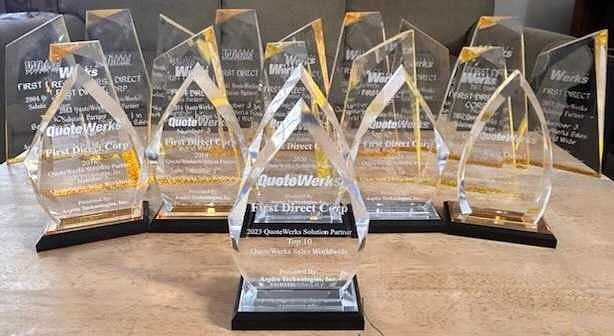
As some of my readers know, First Direct Corp. has won more than our share of sales awards. I could point to a few different reasons for this, but the one I wish to focus on in this article is one you can all benefit from. It’s also one that seems terribly obvious. To sell more … do more! 

What does this have to do with GoldMine? Just about everything. If you ask me, what I like most about GoldMine? – The answer is, the way it lets my organization do more. We can make more calls, do more marketing, stay in touch with more contacts, respond to more inquiries, produce more communications, and just simply do more sales than we could possibly do without the software. In other words, I need GoldMine to sell GoldMine!

I’m always struck by the following reaction some sales people have expressed during the first training session, or even during a demonstration of GoldMine. They’ll say something like this, “You expect me to put all this information into a database … when am I going to have time to sell?” When I hear this I want to say, “Who has the time to sell without GoldMine!?”

When I look back over the many articles I’ve written in the past for this newsletter, as well as the free webinars I’ve hosted, I find numerous topics that I’ve shared with my audience to help them sell more by doing more. Yet, as the old expression goes, “You can lead a horse to water, but you can’t make them drink.” 

GoldMine gives you an enviable toolset to help you and your organization sell more and market better. But you have to make it happen, or get the help you need (shameless plug). If you’ve reached the threshold or the realization that you need to use GoldMine to sell more … schedule a free, no obligation, meeting with me and start to make it happen. 

Take a look at this upcoming webinar – Using GoldMine Through The Eyes of a Sales Rep – A Sales Centric Approach to Using GoldMine.

Comments (0)

Build Voice into Your CRM Solution

Posted on 07 July 2007 by Jay Dymond

These are just a few of the big reasons why integrating your telephone system with your CRM system is appealing:

  • Power-dialing (where your phone system dials contacts in a campaign automatically)can increase telesales productivity by as much as 300%!
  • Using low cost Voice over Internet solutions versus traditional telecommunications carriers can save your organization 50% and more on phone bills.
  • Integrating call tracking with your CRM data can provide major efficiencies and highly useful analytics.

New voice technologies are hot in general!  Expectations are that over 60% of organizations will move to a Voice Over Internet Protocol (VOIP) enabled phone system in the near future.  VOIP has many advantages including the potential to realize significant savings over time.  And, because “Voice over the Internet” enables organizations to extend their “phone system” beyond their physical office, beyond the local area network (LAN) and even beyond their wide area network (WAN) to include remote users, even cell phones. Such greater mobility offers strategic staffing options not available within environments running more traditional “PBX” phone systems.

Access to the low-cost, high-speed Internet access is making an explosion of the VOIP industry possible.  Marketing by residential VOIP providers such as Vonage has raised the awareness of the benefits of this technology. And, many telephony equipment providers such as Avaya, Mitel, 3COM and others who provide are realizing double digit growth.  Systems for small to mid-size businesses by providers such as Altigen and TeleVantage feature incredible functionality.  Software as a Service (Saas) providers have made VOIP easy and economical to deploy rapidly. But VOIP is one part of a better solution.  Phone system without integration to your contact database (CRM system) is still just a phone system, even if it is a better system.  

If you’re a GoldMine user in the market for VOIP, the desire to integrate with your contact database is probably one of the greater concerns facing you.  After all, buying a new phone system is costly enough, so you wouldn’t want to switch CRM systems as well in order to integrate the two. 

There are established vendors with VOIP systems that will integrate with GoldMine out-of-the-box.  But I believe FrontRange’s latest VOIP technology, Voice 5.1, offers superior integration.  With FrontRange Voice (FV) the value of your CRM database is extended to your phone system.  Inbound and outbound calls are more easily tracked.  Integrated screen-pop, power dialing, and skills-based routing provide efficiencies that can add huge value to your organization!

Frankly, I’ve been skeptical of GoldMine’s integrated VOIP technology to this point. FrontRange Solutions introduced Voice over IP products about 18 months ago, called IPCC and GoldMine Voice Suite, but I was not satisfied with their functionality or their stability.  The products needed to mature.  I see positive change coming with the release of FrontRange Voice 5.1.  This product is the next generation of FrontRange’s VOIP system and it incorporates the best of both products on one platform that supports integration between all of FrontRange’s products, HEAT, ITSM, and the full GoldMine CRM line with their Voice 5.1 product.  

FrontRange affirmed their commitment to this technology at the recent national sales conference.   Numerous awards, and over 100 installations, a detailed product map and strong R&D budget, as well as positive feedback by industry analysts on FrontRange’s vision all indicate that FrontRange Voice has a bright future.  So much so that I’m taking the plunge in my firm, First Direct Corp. and converting our phone system over to FrontRange Voice 5.1.  In a phrase, “I’m eating my own dog food.” 

There are many features in FrontRange Voice 5.1 that I’m excited about having, let alone selling.  It’s going to be a huge help with call campaigns.  “Call monitoring” along with “Silent Whispering” are great tools that will help us train and coach representatives.  Call transfer with GoldMine record screen-pop will help our organization’s teamwork. 

Remember, a phone system without integration to you CRM, is still just a phone system.   VOIP and CRM are a winning combination.  To request information on FrontRange Voice 5.1 click here.   

Comments (0)

Using GoldMine Activity & Result Codes

Posted on 04 December 2006 by Jay Dymond

GoldMine has a feature that is available when scheduling and completing activities which is unlike other Contact Management solutions.  GoldMine offers users the ability to “Code” Activities (Calls, Appointment, Actions, Sales, Emails, etc.), as well as the “Results” of those Activities.  The value of “Coding” Activities and Results can come into play in several ways including:

  • Save Time Entering Your Activities – Activity & Result Codes are faster to type than descriptions. Redundant/common actions make appropriate choices for the drop down “pick” list of Activity Codes.  Same is said of “Results.”
  • Organize your Scheduling Activities including Sorting and Filtering as a means to manage your time, by prioritizing or focusing your efforts.  Even viewing your activities on your GoldMine Calendar, and especially your Activity List, can help you to be more effective.  
  • Target Contacts (building GoldMine Filters/Groups) based on Tagged Activities with Certain Codes – can be useful if you want to create a marketing or sales efforts based on records in GoldMine with which a certain activity has been done.
  • Report and Analyze Completed Activities – Metrics can be derived from Activity & Result Codes which can help you manage people, processes, marketing, etc.  

Since the concept of “Activity & Result Codes” is a rather unique concept within GoldMine, many GoldMine administrators don’t quite have a good idea where to begin.  The result of this article is intended to help you with framing your thoughts for how to organize and use your firm’s “Activity & Result Codes.” 

But before I begin, you should know that in most organizations with multiple users of GoldMine the decision to use and configure “Activity & Result Codes” belongs to management and the GoldMine administrator.  In fact, in nearly all cases, I recommend that the right to add/edit/delete to the lookup list for codes is reserved for users with “Master Rights.”

Definitions to Start With:
Activities – Activities are time-specific or event-based actions linked to contacts, such as calls, appointments, letters, etc., or other types of activities, such as To Do tasks or events that are assigned to users. For the most part, GoldMine is designed to link contacts with scheduled activities. This linking allows you to schedule the activity on your calendar and on the contact’s Pending tab. Then, when you complete the activity, it is moved to the contact’s History tab, thereby creating a record of that activity.

Activity Type – GoldMine tracks different “types” of activities (e.g. Calls, Appointments, Next Actions, Other Actions, Sales, etc.).  GoldMine automatically tracks the “user” who enters and completes the activity, along with the respective dates and times.  With respect to each of these Activity Types, GoldMine offers the option to indicate an Activity “Code,” “Reference,” and “Result.” 

Code – generally used to define the purpose or nature of the activity

Reference – generally used to describe what the activity is regarding

Result – generally used to denote the essential outcome of the activity

Considerations:
It is important that Activity Codes and Results, in particular, have “Lookup Lists” for the user to select from.  Furthermore, GoldMine Users should NOT be permitted to add, edit, or delete from these lists.  In other words, the choices for Activity Codes and Results should be predetermined, If they need to be edited, this should be done by the GoldMine Administrator or a user with “Master Rights.”  It is fairly common for GoldMine installations to permit users to manually enter the “Reference” for an Activity while they are scheduling it, although it is beneficial to offer a Lookup list for this entry as well.

The Lookup List for Codes, References, and Results are discrete for each Activity Type.  In other words, the Lookup List for Calls is separate from the Lookup List for Appointments and from Next Actions.

In the database, GoldMine only stores up to three (3) characters for an Activity Code and Result Code.  The Reference is a 40-character field.  Since Activity Codes and Results are limited to three characters, you must develop a list of abbreviations or acronyms to represent the description of your entry.  The Lookup List will display the “Code” along side of the Activity “Description” to help users make their entries. However, only the first three characters are captured in the database when a selection is made.  The most familiar/user friendly way to decide on your codes is generally to use acronyms for multi-word descriptions and abbreviations for single word descriptions.  (See below.)  Do NOT use the same code for multiple meanings!

Used in conjunction with one another, the Activity Type, Code, Reference, and Result provide a rather complete and specific level of detail for reporting and analysis.  Coupled with these details is an opportunity to enter “Notes” pertaining to the Activity.  The “Notes” from a Scheduled (Pending) Activity are carried into the GoldMine Record History when it is completed.  One can add and/or edit those Notes when they “Complete” the Pending Activity.

Examples: 
This list is not intended to be your list!  It is simply some examples to get you thinking/planning.  Ultimately, the list you come up with should represent a “day-in-the-life” for an individual in your organization.  Think in terms of common/redundant activities to get ideas.  Also, try to account for those activities which are important for calculating metrics (measurements).   During the Configuration Planning process that First Direct Corp. does with you, First Direct can help you to get started and to validate your ideas.

ACTIVITY TYPES:

CALLS -

Codes: Sales Follow-up (SF), Technical Support (TS), Prospecting Call (PC), Collections (COL), Schedule Appointment (SA), Customer Service (CS), Sales Inquiry (SI)
Results:  Left Message (LM), Completed (COM), Not Interested (NI), Resolved (RES), Future Follow-up (FF), Request Proposal (RFP), Request Information, (RFI)

APPOINTMENTS - 

Codes: Sales Visit (SV), Training (TRA), Demonstration (DEM), Installation (INT), Vacation (VAC), Personal (PER), Trade Show (TS), Consulting (CNS)
Results:  Completed (COM), Future Follow-up (FF), Request Proposal (RFP), Request  Information, (RFI), Cancelled (CAN), Stood Up (SU), Rescheduled (RES)

NEXT ACTIONS:      

Codes: Send Proposal (SP), Send Material (SM), Project Work (PW), Meeting Preparation (MP), Account Related (AR), Follow Up (FUP)
Results:  Completed (COM), Shipped Regular (SR), Shipped Priority (SP), Mailed (ML), Progress Made (PM)

Please Note:  I have not provided examples for all the Activity Types.  The logic for determining and applying them is very similar.  You are welcome to discuss how Lookup Lists for Activity Codes, References, and Results can be applied to the other Activity Types.

Comments (0)

It’s In Every Sales Course – Is It in Your CRM?

Posted on 25 August 2006 by Jay Dymond

High on the list of important topics in any sales methodology or training program is the need to “sell to the people most likely to buy.”  And, it ought to be in every CRM system!  Is it in yours?

Every salesperson, worth their salt, knows they need to qualify a lead.  There are hot buyers, lookers who may buy, and others who pass your way.  Leads come in all ways – off web forms, on cold call lists, from referrals, through networking, etc.  Either way, the first order of business with leads is to weed through them to separate the wheat from the chaff by qualifying them. 

Qualifying can take the form of questions, knowing the source of the leads, researching them online, or even by floating attractive direct response offers past them with the requirement for certain information. 

Like other vital information on contacts, qualifying details should be databased.  Otherwise, marketing can’t target future marketing communications, and management can’t report and analyze the effectiveness of its efforts. 

Salespeople have a tendency to capture such findings in “notes” rather than in fields.  Part of the reason is that it may seem easier to type this information right along with all the notes about a conversation; and not to bother to update pertinent fields accordingly.  The other reason is sometimes the CRM system lacks the necessary fields and lookups for the data to go into.  This second reason is an oversight that can be easily fixed.  The first is a more challenging issue – changing people’s behavior!

There are several features in GoldMine that your organization can leverage to make it easier to capture qualifying information:

  1. Web Import – capture facts from web forms directly into the corresponding fields in GoldMine.
  2. Auto-data Entry – trigger the population of one field based on values from other fields.  For example, drive the entry of territory and/or sales rep base on “state.” Or, automatically populate a date in a field when a milestone value is entered into another field.
  3. Scripts – a lesser known feature in GoldMine that enables you to design a series of questions with select responses or manual entries that automatically populate the right fields.  Branching logic is a feature of GoldMine scripts, so a particular response can direct the person asking the questions to the appropriate follow-up.
  4. Field Lookups – default choices in fields that can control the values that are entered into fields, thereby ensuring data consistency and integrity, and making it faster and more intuitive for users to fill information in.  (Don’t forget to check off “Auto Fill” in the Lookup Set-up to save users time when entering common choices.)

Changing people’s behavior is easier said than done.  Giving salespeople tools like I’ve listed above will help. Training and reinforcement is a must as well.  But chances are the best reason for them to want to change is if the salespeople see the value in it for them by seeing how the information they capture is used successfully.

Once you’ve incorporated the features in GoldMine into your sales qualifying process, it just makes a whole lot of sense to explore ways marketing and management, let alone sales people, can use this information to sell more, by targeting time, effort, and resources in the direction of the people who are most likely to buy.  If you do, you’re going to increase sales and your ROI!

Comments (0)